


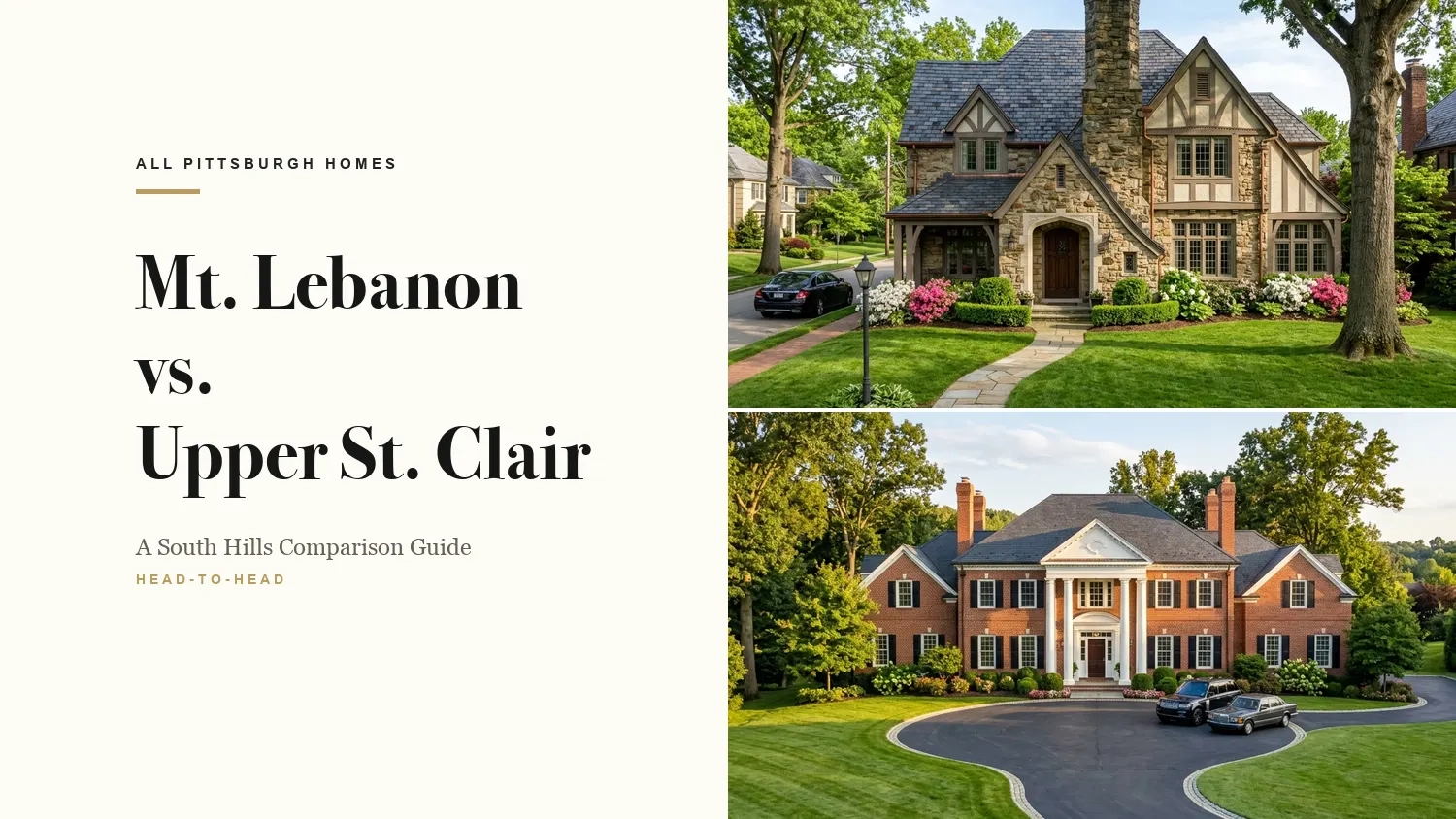
Choosing between Mt. Lebanon and Upper St. Clair is the classic decision confronting homebuyers searching for premier South Hills real estate. While these two prestigious municipalities share a border, top-tier academic reputations, and comparable price points, daily life in each community feels fundamentally distinct.
For prospective homebuyers exploring Western Pennsylvania, evaluating this comparison is a crucial step in finding the right South Hills community. The choice rarely comes down to test scores or investment security, because both townships excel on those metrics. Instead, the decision hinges on daily lifestyle: whether you value early twentieth-century architectural craftsmanship, sidewalks, and light rail transit, or whether you prioritize rolling acreage, attached multi-car garages, cul-de-sac privacy, and extensive community recreation facilities.
1. Head-to-Head Community Comparison: Architectural Charm vs. Suburban Acreage
When assessing South Hills real estate, concrete figures provide clarity before examining neighborhood nuances. Here is how Mt. Lebanon and Upper St. Clair compare across core demographic, housing, commute, and operational categories:
| Metric / Feature | Mt. Lebanon | Upper St. Clair | Competitive Differentiator |
|---|---|---|---|
| Median Single-Family Price | $440,000 | $530,000 | Mt. Lebanon provides a lower entry price point across historic stock |
| Dominant Housing Era | 1920s to 1950s Stone and Brick | 1960s to 1990s Traditional and Custom | Early streetcar craftsmanship vs mid-century executive layouts |
| Typical Lot Size | 0.15 to 0.25 Acres | 0.35 to 1.0+ Acres | Upper St. Clair delivers three to four times more yard acreage |
| Walkability Profile | High WalkScore, Sidewalks Throughout | Car Dependent, Private Cul-de-Sacs | Mt. Lebanon features continuous sidewalk grids and dual commercial town centers |
| Transit to Downtown | PRT Light Rail (T) and Express Bus | Automobile (Route 19) or Park and Ride | Mt. Lebanon offers direct neighborhood walk-on rail access |
| Elementary School Model | 7 Walking Neighborhood Schools (No Buses) | 3 Centralized Elementary Schools (Full Busing) | Mt. Lebanon emphasizes walking cohesion; USC provides bus fleet |
| Secondary Academic Program | Advanced Placement and Honors Focus | Full K-12 International Baccalaureate (IB) | USC offers standardized global IB credentialing; Mt. Lebanon excels in AP |
| Municipal Recreation | Municipal Golf Course, Outdoor Swim, Ice Center | 474-Acre Boyce Mayview Park and Modern C&RC | Mt. Lebanon excels in village sports; USC offers regional parkland |
| Total Composite Millage | Approximately 37.12 Mills | Approximately 36.82 Mills | Negligible variance of roughly 0.30 mills across identical county rules |
2. Architectural Eras, Lot Configurations, and Topography
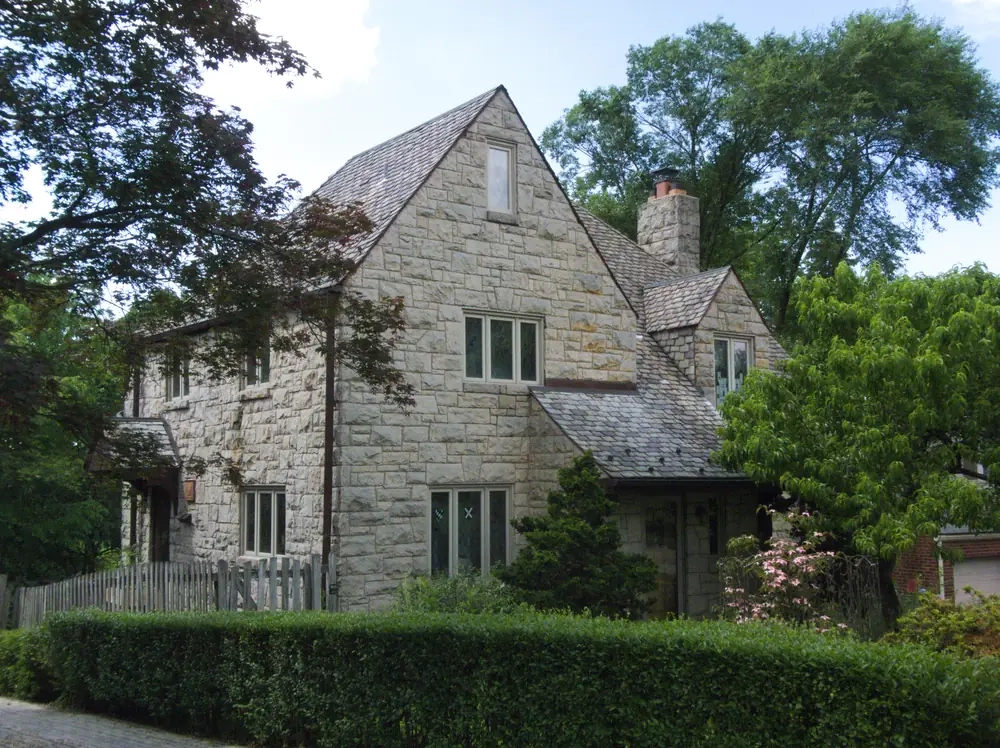
The visual character of your street represents the most immediate difference between these two townships. Mt. Lebanon developed primarily as an early streetcar suburb between 1920 and 1950. Builders constructed substantial stone Tudors, brick Colonials, and English Cotswold cottages with slate roofs, copper gutters, and hand-carved interior millwork. If you appreciate historic leaded glass windows, plaster crown moldings, and solid oak hardwoods, you will find an extraordinary concentration of timeless residential architecture throughout Mt. Lebanon neighborhoods like Mission Hills, Virginia Manor, and Hoodridge.
However, historic craftsmanship comes with practical trade-offs that prospective buyers must evaluate objectively. Basements in Mt. Lebanon homes often feature original stone foundations and integral single-car garages tucked beneath the living quarters. These narrow driveways can prove challenging during snowy Pittsburgh winters. Backyard footprints are modest, averaging between one-sixth and one-quarter of an acre, placing your outdoor patio in clear view of adjacent neighbors.
Upper St. Clair represents mid-to-late twentieth-century suburban planning executed with exceptional precision. As families migrated south following World War II and the expansion of regional roadway networks, Upper St. Clair developed expansive subdivisions featuring center-hall Colonials, sprawling brick ranches, and multi-level split designs. Developments from the 1970s through the 1990s, such as Westminster, Deerfield, and Rolling Green, offer two-car and three-car attached garages on the main living level, expansive primary bedroom suites, open kitchen family room layouts, and dedicated mudrooms.
Lot sizes in Upper St. Clair frequently span from one-third of an acre to well over an acre. If your household prioritizes an inground swimming pool, a sprawling play structure, a detached gardening workshop, or simply private perimeter tree lines buffering you from neighboring properties, Upper St. Clair delivers that breathing room in abundance. Homebuyers can review active listings across both styles by exploring the regional property directories for Mt. Lebanon homes for sale and Upper St. Clair real estate.
3. Walkability, Town Centers, and Daily Commercial Rhythm
Daily routines feel fundamentally different depending on which side of Gilkeson Road you select. Mt. Lebanon operates with an urban-suburban tempo that is rare across Allegheny County. The municipality was intentionally engineered around the pedestrian experience, featuring sidewalks lining virtually every street, mature tree canopies, and distinct commercial business districts.
Residents in Mt. Lebanon frequently walk to morning coffee, the public library, local banks, and evening dinner. The primary Uptown commercial spine along Washington Road offers independent coffee roasters, medical offices, boutiques, and diverse restaurants. A second vibrant commercial corridor sits along Beverly Road, anchored by a neighborhood grocery store, ice cream parlors, coffee spots, and pizza shops. Living in Mt. Lebanon means children can walk to athletic games, music lessons, and neighborhood friends without requiring parent car trips for every excursion.
Upper St. Clair delivers a serene, automobile-centered residential sanctuary. The township intentionally restricted commercial retail to select perimeter highway corridors, primarily along Route 19 (Washington Road). As a result, residential subdivisions remain peaceful, quiet enclaves free from commercial cut-through traffic. Children play safely in quiet cul-de-sacs and ride bicycles on private neighborhood loop streets.
Running daily errands in Upper St. Clair centers on convenient retail shopping centers. Residents enjoy immediate access to South Hills Village, Norman Centre, and Siena at St. Clair, an upscale lifestyle development featuring Whole Foods Market, boutique specialty fitness studios, and sit-down dining. While you will rarely walk from your front porch to pick up groceries, everything your household requires sits within an easy five to ten minute drive. For a detailed orientation on southern Allegheny County lifestyle patterns, see the comprehensive guide on moving to Mt. Lebanon PA as well as the in-depth review on moving to Upper St. Clair PA.
4. Commute Logistics: Light Rail T Stops vs. Highway Routes
Transportation logistics often serve as the decisive factor for professionals commuting into Downtown Pittsburgh, the Cultural District, or the university medical corridors in Oakland. In this arena, Mt. Lebanon holds an exceptional advantage thanks to rail infrastructure.
Pittsburgh Regional Transit (PRT) operates the light rail system, known locally as the T. Two distinct light rail lines, the Red Line and Blue Line, cut directly through Mt. Lebanon, with popular passenger stations at Clearview, Mt. Lebanon Station, Poplar, and Arlington. Commuters board the train, sit back without battling highway congestion, and arrive at Downtown subway stops like Steel Plaza or Gateway Center in twenty to twenty-five minutes. During major winter storms or tunnel construction closures, light rail transit provides dependable, stress-free mobility.
Upper St. Clair commuters rely primarily on private vehicles or park-and-ride commuter transit. The primary driving corridor is Route 19 North through Mt. Lebanon and Dormont, continuing through the Liberty Tunnels or the West End Bypass into the city core. During peak morning rush hours, highway congestion near the tunnel portals can push drive times to forty-five minutes or more.
Upper St. Clair residents seeking transit alternatives utilize the southern light rail terminus parking facilities. The South Hills Village Park and Ride station sits directly on the Upper St. Clair border, offering a multi-level garage where residents park their cars before boarding the T. This setup works smoothly for many hybrid professionals, though it does add a vehicular leg to your morning routine.
| Commute Scenario | Mt. Lebanon Route and Travel Time | Upper St. Clair Route and Travel Time | Commute Trade-off Analysis |
|---|---|---|---|
| Downtown via Light Rail (T) | 20 to 25 minutes from neighborhood walk-on stops (Clearview, Poplar, Mt. Lebanon Station) | 38 to 42 minutes total travel time via South Hills Village Park and Ride (including parking) | Mt. Lebanon eliminates driving and parking steps entirely with walk-on neighborhood boarding |
| Downtown via Automobile | 18 minutes off-peak, 35 to 50 minutes peak morning rush via West Liberty Ave and Liberty Tunnels | 25 minutes off-peak, 45 to 60 minutes peak morning rush via Route 19 North through Liberty Tunnels | Both corridors encounter congestion at Liberty Tunnels; Mt. Lebanon sits closer to the portal |
| Pittsburgh International Airport | 22 miles, 28 minutes off-peak, 38 minutes peak via I-376 West | 18 miles, 24 minutes off-peak, 32 minutes peak via Route 19 to I-79 North to I-376 West | Upper St. Clair provides superior highway connectivity to I-79 for western airport travel |
| Oakland Medical & University District | 8 miles, 25 minutes off-peak, 45 minutes peak via West Liberty Ave to Birmingham Bridge | 12 miles, 30 minutes off-peak, 52 minutes peak via Route 19, Liberty Tunnels, and Boulevard of the Allies | Mt. Lebanon provides faster surface-street routing into Oakland without southern expressway merges |
For additional regional perspective on regional travel corridors, review the comparative analysis of South Hills versus North Hills commute corridors.
5. Public School Philosophy: Neighborhood Walking vs. District IB Standards
Both school systems rank consistently among the top five public school districts across Western Pennsylvania and place within the upper echelon of statewide academic performance. Families relocating to either district enjoy exceptional honors coursework, distinguished faculty, competitive athletics, and robust performing arts programs. However, their structural execution differs substantially.
Mt. Lebanon School District: The Neighborhood Model
The Mt. Lebanon School District educates approximately 5,300 students across seven neighborhood elementary schools, two middle schools (Mellon and Jefferson), and a single high school campus. The defining hallmark of Mt. Lebanon elementary education is the walk-to-school model. The district does not provide yellow bus transportation for the vast majority of elementary students, meaning children walk to their neighborhood school accompanied by parents or crossing guards.
This neighborhood school framework fosters immense community cohesion. Families get to know their immediate neighbors on the morning walking routes, and school playgrounds serve as central neighborhood social parks after dismissal. Mt. Lebanon High School features a state-of-the-art facility completed after a comprehensive $110,000,000 renovation, providing collegiate-grade science labs, fine arts studios, athletic complexes, and an extensive catalog of Advanced Placement courses.
Upper St. Clair School District: The International Baccalaureate Standard
The Upper St. Clair School District serves roughly 4,100 students across three elementary schools (Baker, Eisenhower, and Streams), two middle schools (Fort Couch and Boyce), and Upper St. Clair High School. Because the township covers ten square miles of rolling terrain, the district operates a comprehensive bus fleet, transporting children safely from their subdivision corners directly to campus doors.
Upper St. Clair distinguishes itself academically as a fully authorized International Baccalaureate (IB) World School district. The IB curriculum begins in elementary school through the Primary Years Programme and extends through the Middle Years Programme to the rigorous IB Diploma Programme at the high school level. This global inquiry-based framework attracts international families, corporate executives, and university faculty seeking an internationally standardized educational philosophy.
6. Property Taxes, Millage Rates, and Escrow Calculations
Property taxes represent an essential consideration when calculating your total monthly carrying cost in Allegheny County. Because both Mt. Lebanon and Upper St. Clair sit within the same county jurisdiction, property owners in both townships pay the standard Allegheny County tax rate alongside their local municipal and school district taxes.
In Pennsylvania, property taxes are calculated using millage rates, where one mill equals one dollar of tax for every one thousand dollars of assessed property value. Let us examine the composite millage breakdown across both townships:
| Taxing Authority | Mt. Lebanon Millage | Upper St. Clair Millage |
|---|---|---|
| Allegheny County | 4.73 Mills | 4.73 Mills |
| School District | 26.96 Mills | 27.56 Mills |
| Municipality / Township | 5.43 Mills | 4.53 Mills |
| Total Composite Millage | 37.12 Mills | 36.82 Mills |
Monthly Mortgage and Tax Escrow Simulation
To understand what this means in practical terms, prospective buyers should evaluate monthly escrow obligations across common price brackets. The simulation below illustrates estimated property taxes and monthly escrow payments across $500,000, $750,000, and $1,000,000 benchmark home purchases:
| Benchmark Purchase Price | Mt. Lebanon Annual Tax (Est.) | Upper St. Clair Annual Tax (Est.) | Mt. Lebanon Est. Monthly Escrow | Upper St. Clair Est. Monthly Escrow | Net Monthly Variance |
|---|---|---|---|---|---|
| $500,000 Purchase Benchmark | $18,560 per year | $18,410 per year | $1,547 per month | $1,534 per month | Mt. Lebanon +$13 per month |
| $750,000 Purchase Benchmark | $27,840 per year | $27,615 per year | $2,320 per month | $2,301 per month | Mt. Lebanon +$19 per month |
| $1,000,000 Purchase Benchmark | $37,120 per year | $36,820 per year | $3,093 per month | $3,068 per month | Mt. Lebanon +$25 per month |
As this calculation illustrates, the tax disparity between the two townships is negligible, amounting to less than $25 per month even on a luxury $1,000,000 asset. Both municipalities face identical Allegheny County assessment guidelines and Common Level Ratio appeal dynamics. When shopping between these communities, property taxes should not be your primary differentiator. Instead, focus your evaluation on home layout, lot utility, and daily transportation convenience. For additional guidance on negotiating real estate transactions, explore the comprehensive resources for homebuyers across Greater Pittsburgh.
7. Municipal Amenities: Mt. Lebanon Ice Center vs. Boyce Mayview C&RC
Both townships demonstrate deep municipal commitment to public parks and recreation, though their facilities mirror their overall urban versus suburban design philosophies.
Mt. Lebanon operates a compact, highly integrated municipal recreation core clustered near Cedar Boulevard. The township maintains a public nine-hole golf course, an Olympic-sized outdoor swim center, regulation platform tennis courts, and a premier indoor ice skating center that hosts year-round figure skating and youth ice hockey leagues. In addition, Mt. Lebanon maintains numerous neighborhood green spaces, including Williamsburg Park, Bird Park, and the walking trails weaving through Mt. Lebanon Main Park.
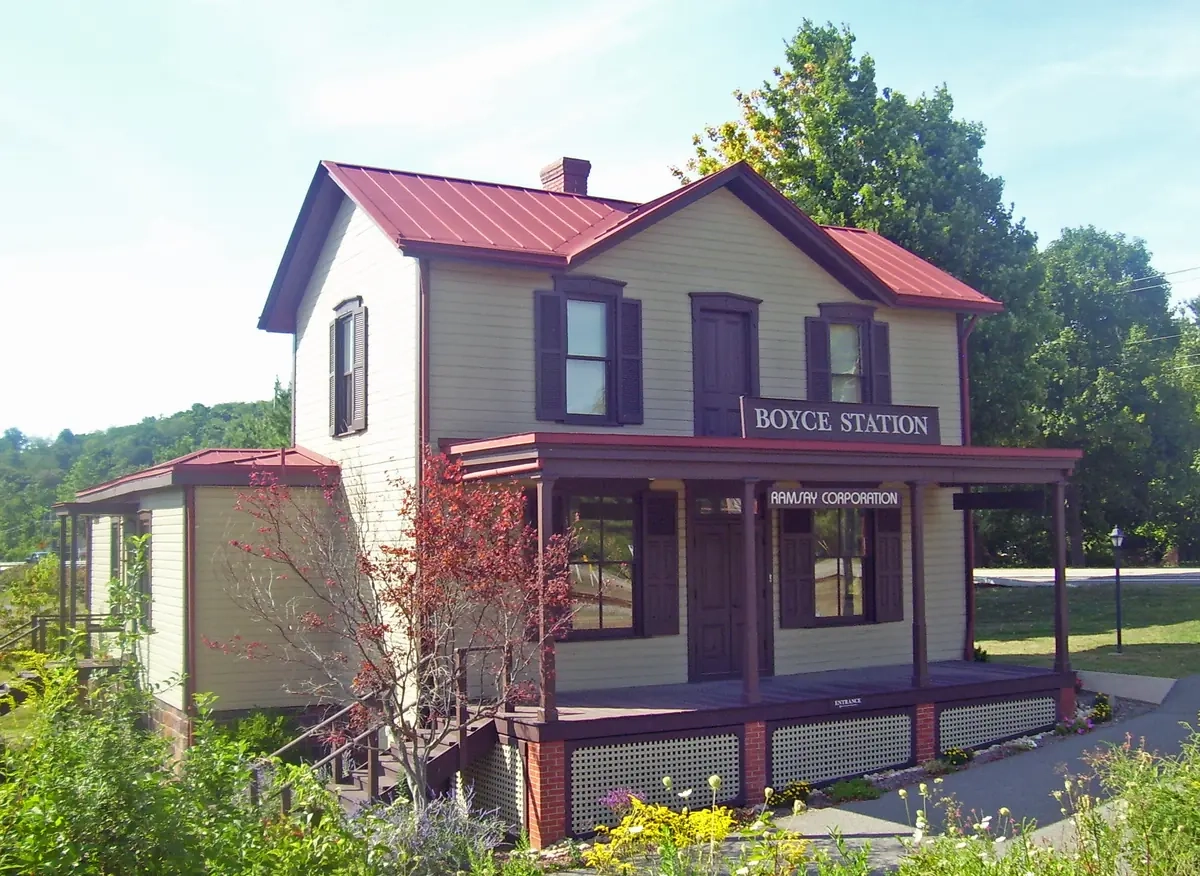
Upper St. Clair features Boyce Mayview Park, an extraordinary 474-acre municipal treasure. This expansive regional facility includes paved nature trails, wetland boardwalks, bird observation blinds, athletic ballfields, and community garden plots. Anchoring the park is the Community and Recreation Center (C&RC) at Boyce Mayview, a modern multi-million dollar complex featuring indoor and outdoor aquatic facilities, zero-depth entry family pools, fitness studios, gymnasium courts, and community event programming. Residents also enjoy the scenic grounds of St. Clair Country Club and the tennis facilities at municipal courts throughout the township.
8. Home Price Brackets and Market Inventory Profiles
The South Hills real estate market remains consistently competitive due to steady buyer demand driven by public school rankings and close proximity to Downtown employment hubs. Here is how housing inventory breaks down across entry, mid-tier, and luxury brackets in both communities:
The Entry Tier: $300,000 to $450,000
In Mt. Lebanon, this price bracket offers classic three-bedroom, one-and-a-half-bath brick Colonials, split-levels near Castle Shannon, and charming brick capes along Sunset and Markham corridors. These properties often require interior cosmetic updates such as kitchen refinishing or bathroom modernization. In Upper St. Clair, standalone single-family inventory below $400,000 is exceptionally limited. Buyers in this range generally target low-maintenance townhome developments or older mid-century ranches needing comprehensive interior renovations.
The Core Move-Up Tier: $500,000 to $750,000
This bracket represents the heart of the South Hills family housing market. In Mt. Lebanon, buyers discover beautifully maintained stone Tudors and four-bedroom brick homes featuring updated mechanical systems, finished third-floor attics, and modern kitchens in areas like Markham, Howe, and Sunset Hills. In Upper St. Clair, this tier unlocks classic four-bedroom two-story Colonials in subdivisions like Deerfield, Trotwood Acres, and Rolling Green, featuring two-car attached garages, private half-acre lots, and spacious family rooms with brick fireplaces.
The Executive and Luxury Tier: $800,000 to $1,500,000+
In Mt. Lebanon, luxury properties center on historic estates in Virginia Manor and Mission Hills. These stately homes feature hand-chiseled fieldstone exteriors, quarter-acre to half-acre mature grounds, slate roofing, carriage houses, and chef-grade modern renovations. In Upper St. Clair, the luxury tier showcases custom architectural builds in premier enclaves like Westminster Manor, Bedner Estates, and novel luxury subdivisions offering open floor plans, soaring two-story great rooms, three-car garages, and private outdoor swimming pools. For a focused look at specific neighborhoods, consult the comprehensive guide to the best neighborhoods in Mt. Lebanon PA.
9. Strategic Selection Framework: Choosing Between the South Hills Giants
When evaluating the choice between these two premier South Hills townships, prospective residents should assess their lifestyle priorities against this structured comparison framework:
Choose Mt. Lebanon If:
- You value authentic historic architecture, slate roofs, interior plaster detailing, and stone craftsmanship.
- You want to walk to dinner, the library, coffee shops, and local grocery stores directly from your front door.
- Your commute takes you directly to Downtown Pittsburgh and you want to ride the T light rail without driving to a parking garage.
- You appreciate a tight-knit neighborhood school culture where children walk to class alongside neighborhood peers.
- You prefer low-maintenance yard sizes that do not require entire weekends of lawn care and landscaping.
Choose Upper St. Clair If:
- You desire a larger lot with privacy, tree buffers, room for recreation, or space for an inground swimming pool.
- You prioritize modern functional layouts, attached multi-car garages on the main living level, and open concept living spaces.
- You value the International Baccalaureate curriculum and desire comprehensive yellow bus transportation from kindergarten through graduation.
- You want immediate access to expansive municipal amenities like the 474-acre Boyce Mayview Park and the modern Community and Recreation Center.
- You prefer peaceful, private cul-de-sac streets shielded from commercial traffic and through-commuters.
10. Frequently Asked Questions About Mt. Lebanon and Upper St. Clair
Is Mt. Lebanon more walkable than Upper St. Clair?
Yes, Mt. Lebanon features a dense sidewalk network, neighborhood commercial districts on Washington Road and Beverly Road, and light rail transit stops. Upper St. Clair is predominantly residential and automobile dependent.
How do property taxes compare between Mt. Lebanon and Upper St. Clair?
Both municipalities sit in Allegheny County and carry comparable total composite millage rates around 36.8 to 37.1 mills. On an assessed value of $500,000, annual property taxes range between $18,400 and $18,600 in both communities.
Do elementary students get bus transportation in Mt. Lebanon?
Mt. Lebanon operates a traditional neighborhood school model where most elementary students walk to class, with busing provided only under specific hazardous road conditions. Upper St. Clair provides district-wide yellow bus transportation for all grade levels.
What is the commute time to Downtown Pittsburgh from both suburbs?
Mt. Lebanon commuters reach Downtown in 20 to 30 minutes via the Pittsburgh Regional Transit light rail T line or West Liberty Avenue. Upper St. Clair drivers average 30 to 45 minutes along Route 19 through the Liberty Tunnels or Fort Pitt Tunnels.
Which suburb offers larger residential lots?
Upper St. Clair offers significantly larger lot sizes, typically ranging from one-third acre to over an acre in planned subdivisions. Mt. Lebanon properties average between 0.15 and 0.25 acres with closer neighbor proximity.
11. Planning Your South Hills Home Search: Due Diligence and Next Steps
Whether the historic streetcar charm of Mt. Lebanon or the spacious suburban acreage of Upper St. Clair speaks to your household goals, both communities represent outstanding real estate investments with enduring equity preservation. When touring homes, pay close attention to your daily habits: your morning commute, how your children travel to school, and how you spend your weekend leisure hours.
Whether you choose the historic pedestrian charm of Mt. Lebanon or the sprawling acre lots and modern amenities of Upper St. Clair, both communities offer premier education and enduring real estate value. Comparing tax millage rates, commute preferences, and architectural styles provides the foundation for an exceptional South Hills living experience. Prospective buyers can explore pedestrian-friendly alternatives in our walkable Pittsburgh suburbs guide to compare regional housing stock across Allegheny County.