


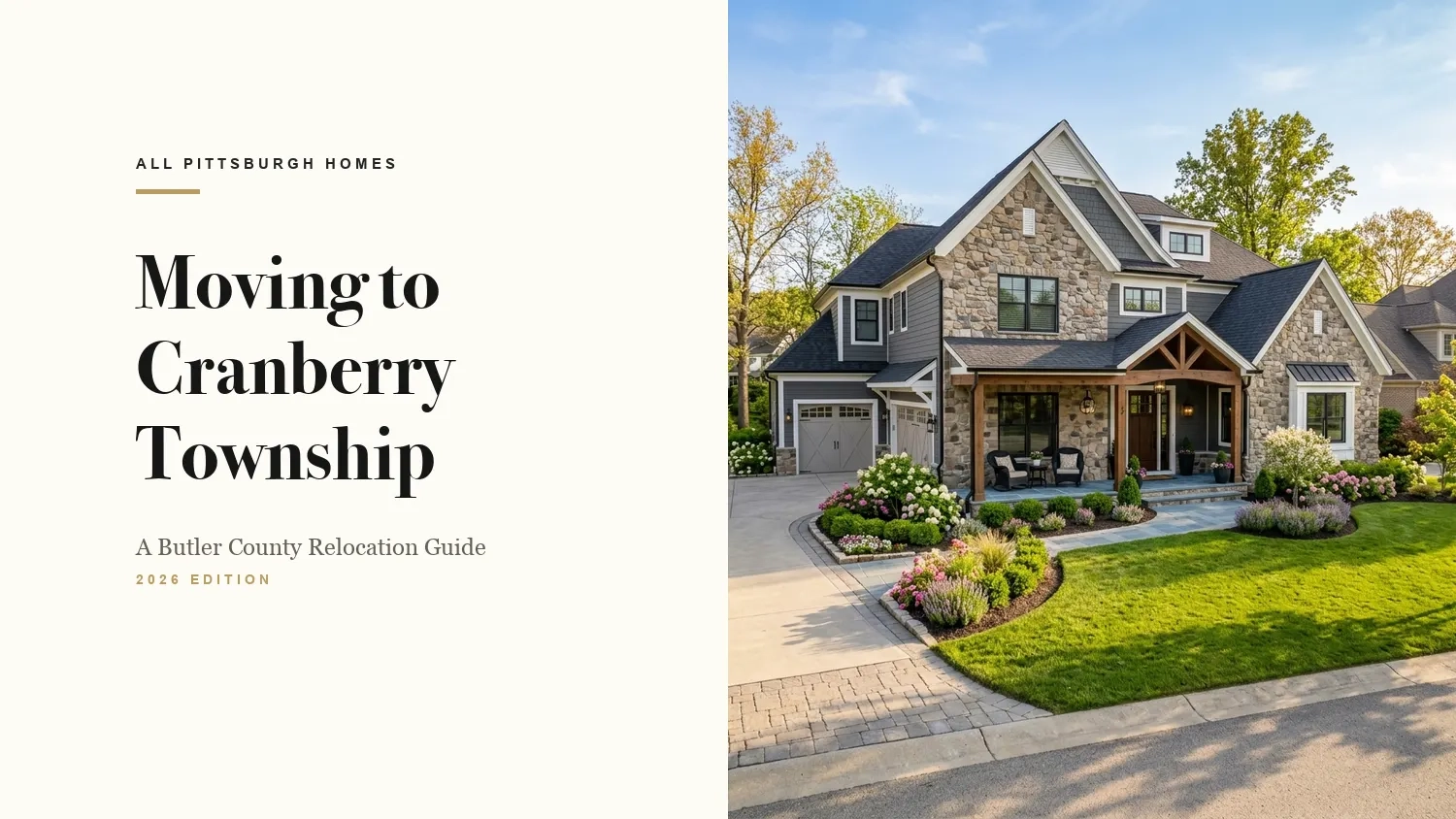
For out-of-state corporate transfers and regional move-up buyers seeking a balance between nationally recognized public schools, modern housing inventory, and lower property taxes, Cranberry Township consistently serves as a premier destination in Western Pennsylvania. Situated directly across the Allegheny County border in southwestern Butler County, Cranberry has evolved from an agricultural crossroads into one of the region's primary economic and residential powerhouses.
Choosing where to establish roots is a major financial and lifestyle decision. Relocating to Cranberry Township delivers substantial financial benefits, but it also introduces practical trade-offs that every homebuyer must evaluate before submitting a purchase agreement. This relocation guide analyzes the Butler County tax structure, Seneca Valley academic configurations, Interstate 79 commute corridors, neighborhood price tiers, and daily municipal infrastructure.
Cranberry Township covers approximately 23 square miles at the junction of southwestern Butler County, Beaver County, and northern Allegheny County. Over the last four decades, the township has expanded from a quiet rural community into a thriving suburban center with more than 33,000 residents. This rapid population growth has been driven by deliberate municipal planning, modern infrastructure investments, and a business-friendly environment that attracts regional corporate headquarters.
Unlike inner-ring Pittsburgh suburbs characterized by century-old stone colonials and streetcar grids, Cranberry offers master-planned subdivisions, spacious curvilinear street layouts, expansive public parks, and extensive commercial corridors. Homebuyers relocating from metropolitan areas like New York, Washington D.C., Chicago, or San Francisco frequently find Cranberry familiar in its suburban convenience, retail abundance, and contemporary home designs. To explore active listings in the area, prospective purchasers can review Cranberry Township homes for sale across diverse neighborhoods.
The single greatest financial incentive drawing homebuyers across the county boundary into Cranberry Township is property tax arbitrage. Real estate taxes in Pennsylvania comprise three distinct millage levies: county millage, municipal millage, and school district millage. Because Cranberry is located in Butler County rather than Allegheny County, homeowners benefit from a substantially lower composite tax burden and a more predictable assessment environment.
In Allegheny County suburbs such as McCandless, Upper St. Clair, or Mt. Lebanon, effective property tax burdens routinely range from 2.5 percent to 3.2 percent of market value following post-sale assessment updates. In Cranberry Township, the effective combined tax burden generally sits between 1.4 percent and 1.7 percent of actual market value. On a $450,000 home purchase, this differential saves homeowners between $3,500 and $5,500 each year in escrow expenses. On an executive property purchased for $750,000, annual tax savings can easily reach $8,000 to $10,000.
Furthermore, Butler County does not impose the 1 percent local sales tax surcharge present in Allegheny County. While Pennsylvania maintains a base state sales tax of 6 percent, Allegheny County levies an additional 1 percent, bringing their total to 7 percent. In Cranberry, daily retail purchases remain at the standard 6 percent state rate. Over years of homeownership, these compounding tax differences preserve significant household equity. Homebuyers can review historical assessment patterns in our Allegheny County versus Butler County property tax comparison.
| Taxing Entity / Assessment Metric | Cranberry Twp (Butler County) | McCandless Twp (Allegheny County) | Annual Homebuyer Financial Impact |
|---|---|---|---|
| County Millage Rate | 27.64 mills (predetermined base) | 4.73 mills (unified county base) | Butler County maintains lower effective county millage |
| Municipal Millage Rate | 13.25 mills | 1.24 mills | Cranberry funds extensive municipal park services |
| School District Millage Rate | 123.10 mills (Seneca Valley) | 19.74 mills (North Allegheny) | Nominal millage reflects county assessment base differences |
| Effective Combined Tax Rate | Approx. 1.5% to 1.7% of market value | Approx. 2.8% to 3.1% of market value | Effective tax rate is 40% to 45% lower in Cranberry |
| Estimated Annual Taxes ($450,000 Home) | $7,200 | $12,600 | Annual savings of $5,400 ($450 per month in escrow) |
| Estimated Annual Taxes ($750,000 Home) | $12,000 | $21,000 | Annual savings of $9,000 ($750 per month in escrow) |
| Common Level Ratio (CLR) Reverse Appeals | Rarely contested by school district | Automatic reverse appeals common | Higher budgetary predictability in Butler County |
| Earned Income Tax (EIT) | 1.0% (0.5% Twp / 0.5% School) | 1.0% (0.5% Twp / 0.5% School) | Identical baseline earned income tax rate |
| Deed Transfer Tax Rate | 2.0% (1% State, 0.5% Twp, 0.5% SD) | 2.0% (1% State, 0.5% Twp, 0.5% SD) | Standard 50/50 split between buyer and seller at closing |
Public education is a top priority for families relocating to Cranberry Township. The municipality is served entirely by the Seneca Valley School District, an expansive public school system serving more than 7,200 students across nine educational facilities. The district spans Cranberry Township, Forward Township, Jackson Township, Lancaster Township, and several historic boroughs including Zelienople and Harmony.
What distinguishes Seneca Valley from many older Allegheny County districts is its campus organization. Elementary students attend community facilities within the township, such as Rowan Elementary, Haine Elementary, or the state-of-the-art Ehrman Crest Elementary and Middle School. When students enter secondary grades, they transition to the centralized secondary campus located minutes north in Jackson Township.
The centralized secondary campus brings students together for Seneca Valley Middle School (grades 7 and 8), Seneca Valley Intermediate High School (grades 9 and 10), and Seneca Valley Senior High School (grades 11 and 12). This unified campus design allows the district to support college-level science laboratories, specialized technical classrooms, broadcast production studios, and competitive athletic complexes. Athletics and performing arts compete at the highest Western Pennsylvania Interscholastic Athletic League (WPIAL) quad-A and six-A classification tiers.
Seneca Valley operates the Academy of Choice, providing customized cyber, blended, and performing arts curricula for students seeking specialized academic schedules. The district has received regional acclaim for its early STEM education, competitive robotics programs, and dual-enrollment college partnerships with the University of Pittsburgh and Butler County Community College.
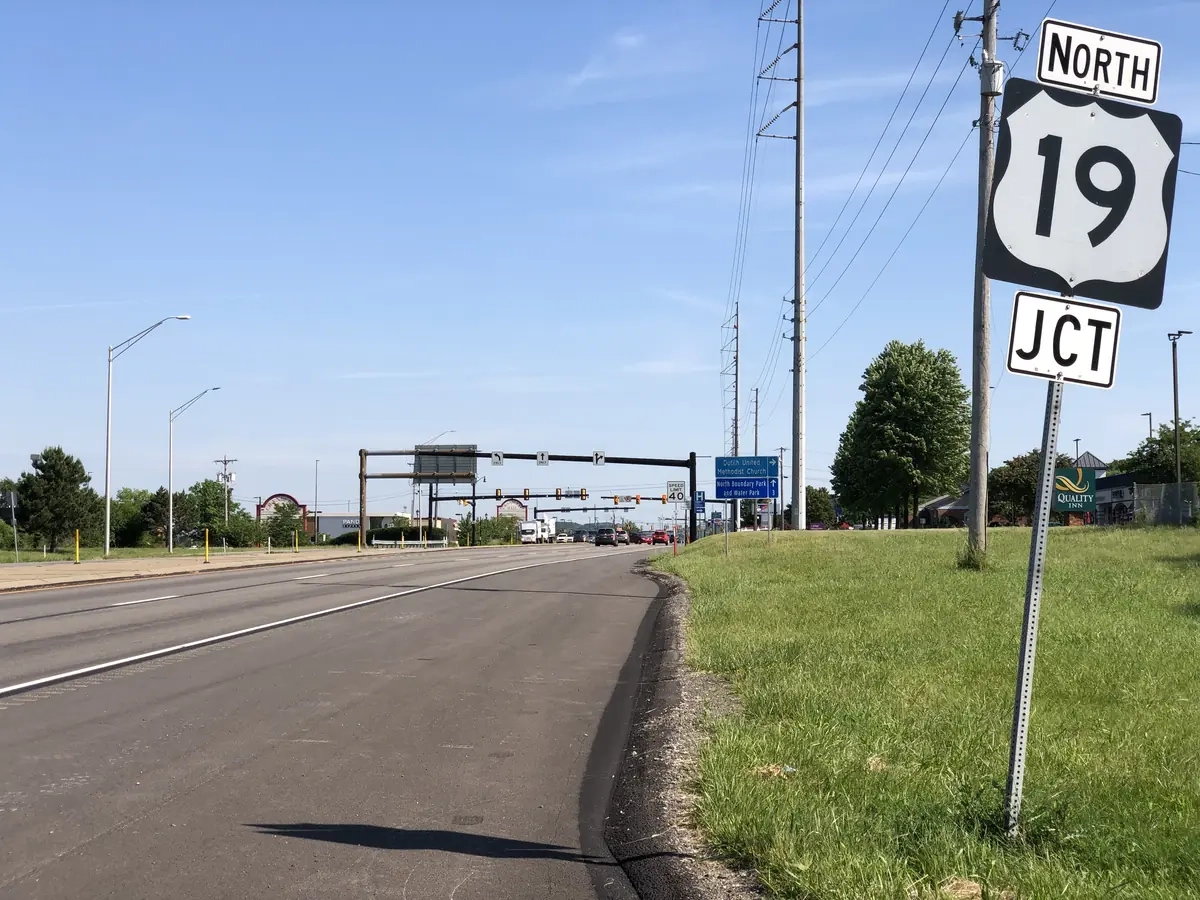
Cranberry Township serves as the northern transportation crossroads of the Greater Pittsburgh region. The township sits directly at the convergence of Interstate 79, the Pennsylvania Turnpike (Interstate 76), and U.S. Route 19. This highway nexus provides exceptional mobility in all four directions, making it ideal for professionals whose careers require regional travel across Western Pennsylvania, eastern Ohio, and West Virginia.
Commuting into Downtown Pittsburgh is straightforward. Under typical midday driving conditions, the 20-mile trip south along Interstate 79 to Interstate 279 takes twenty-five to thirty minutes. During the morning rush hour between 7:00 AM and 8:30 AM, highway volume near the Interstate 279 merge can extend travel times to forty to fifty-five minutes. However, because Cranberry commuters avoid the river tunnel bottlenecks of the South Hills, morning commute times remain comparatively predictable.
| Destination | Primary Highway Route | Off-Peak Drive Time | Morning Peak Drive Time | Transit Alternatives & Highway Notes |
|---|---|---|---|---|
| Downtown Pittsburgh (Golden Triangle) | I-79 South to I-279 South | 25 to 30 minutes | 40 to 55 minutes | I-279 HOV lanes open; Butler Transit express bus takes 40 minutes |
| Oakland Medical & University Center | I-279 South to I-376 East | 32 to 38 minutes | 50 to 65 minutes | Congestion typical near Boulevard of the Allies and Bates Street |
| Pittsburgh International Airport (PIT) | I-79 South to I-376 West | 28 to 32 minutes | 35 to 45 minutes | Direct western highway bypass with zero river tunnel crossings |
| Cranberry Woods & Thorn Hill Industrial Park | Route 19 / Freedom Road | 5 to 8 minutes | 8 to 14 minutes | Local surface roads; minimal delay outside peak shift changes |
| Wexford Commercial Hub (Pine / Marshall) | Route 19 South | 8 to 12 minutes | 12 to 18 minutes | Direct commercial arterial connection across county line |
For commuters who prefer to avoid driving into downtown parking garages, Butler County Transit operates commuter express motor coach service from the Cranberry Township Park and Ride lot near Route 19 and the Turnpike. These express buses travel directly to Downtown Pittsburgh and the North Shore, offering dedicated seating and onboard Wi-Fi for corporate and healthcare professionals.
Unlike historic inner-ring communities where residential properties date to the 1920s or 1930s, Cranberry Township consists almost entirely of modern subdivisions built from the mid-1980s through the present day. Homes feature open floor plans, attached two-car and three-car garages, finished basements, multi-zone HVAC systems, and usable quarter-acre to half-acre lawns.
The housing market accommodates multiple buyer segments, from buyers seeking low-maintenance patio homes to executives purchasing luxury custom estates. Prospective buyers can explore detailed enclave profiles in our guide to the best neighborhoods in Cranberry Township.
| Price Bracket | Housing Archetype & Vintage | Typical Finished Area | Example Subdivisions & Enclaves | Key Architectural Features |
|---|---|---|---|---|
| Entry & Patio Homes ($320,000 to $450,000) | Attached townhomes and single-level patio homes (1990 to 2015) | 1,500 to 2,200 sq ft | Fox Run, Park Place Townhomes, Traditions of Cranberry | Low-maintenance living, HOA lawn care, main-level primary suites |
| Move-Up Single-Family ($450,000 to $650,000) | Two-story brick and vinyl traditional colonials (1995 to 2012) | 2,400 to 3,400 sq ft | Cranberry Heights, Woodbine, Freedom Woods | Integral 2-car garages, finished lower levels, neighborhood sidewalks |
| Executive Custom ($650,000 to $950,000) | Custom brick and stone residences (1998 to 2020) | 3,400 to 4,800 sq ft | Ehrman Farms, Shadow Creek, Pinehurst | 3-car garages, gourmet kitchens, half-acre lots, private tree buffers |
| Luxury Custom Estates ($950,000 to $1,600,000+) | Architectural custom estates (2010 to present) | 4,800 to 7,000+ sq ft | Cranberry Highlands, Reserve at Ehrman Farms | Expansive acreage, golf course views, designer finishes, smart home tech |
Each residential enclave in Cranberry Township offers distinct community amenities, architectural styles, and lot characteristics. Understanding these subdivisions helps buyers target their home search effectively.
Ehrman Farms stands as one of the township's premier executive communities. Built primarily between the late 1990s and mid-2000s, this neighborhood features custom brick and stone residences situated on rolling, mature lots. Homes here typically offer 3,400 to 5,000 square feet of finished living space, four or five bedrooms, and three-car garages. Resale values in Ehrman Farms generally range from $650,000 to $950,000.
Park Place is a neo-traditional master-planned community designed around walkability and shared amenities. The development integrates single-family craftsman residences, luxury townhomes, pocket parks, a community clubhouse, and a swimming pool. Park Place appeals to buyers who desire community interaction and pedestrian access to neighborhood retail. Properties in Park Place range from $380,000 for upscale townhomes to $650,000 for detached single-family residences.
Cranberry Heights and Shadow Creek offer established suburban neighborhoods with classic two-story designs and mature streetscapes. Cranberry Heights features spacious traditional homes trading between $450,000 and $650,000, while Shadow Creek provides custom architectural variations and larger footprints trading between $550,000 and $800,000. Buyers evaluating nearby Allegheny County alternatives can review our detailed comparison of Cranberry Township versus Wexford.
Cranberry Township is far more than a residential bedroom community; it is a major regional employment center. The township is anchored by Cranberry Woods Business Park, an expansive campus that houses the global headquarters of Westinghouse Electric Company. Thousands of nuclear engineers, technical professionals, and corporate executives work within the township, allowing many residents to enjoy short daily commutes.
In addition to Westinghouse, Cranberry hosts substantial regional operations for companies in healthcare, advanced manufacturing, financial services, and telecommunications. UPMC Lemieux Sports Complex, operated collaboratively with the Pittsburgh Penguins, serves as a comprehensive sports medicine facility, physical therapy clinic, and primary practice facility for the NHL hockey team.
The commercial corridors along U.S. Route 19 and Pennsylvania Route 228 provide extensive retail options, including regional supermarkets, home improvement centers, specialty boutiques, and diverse dining choices. Daily necessities and professional services are easily accessible within a ten-minute drive of most residential neighborhoods.
Cranberry Township has invested heavily in municipal park infrastructure, creating exceptional recreational amenities for families and active adults. The municipality maintains three major public parks comprising hundreds of acres of protected green space.
Graham Park is the centerpiece of Cranberry's outdoor recreation network. Spanning over 115 acres, Graham Park features synthetic turf soccer and lacrosse fields, lighted baseball diamonds, dedicated pickleball courts, basketball courts, and the Miracle League field for athletes with special needs. A paved walking and cycling trail loops the park perimeter, providing safe space for daily exercise.
Cranberry Township Community Park on Route 19 features the township waterpark, with zero-depth pool entry, waterslides, and swim instruction programs. The complex also houses tennis courts, ballfields, playgrounds, and the Rotary dog park. North Boundary Park offers a championship disc golf course, a municipal nature trail network, and a competition-grade BMX track.
An objective evaluation of Cranberry Township requires examining the practical trade-offs alongside its advantages. Understanding daily traffic patterns and rapid commercial growth prevents surprises after moving in.
The primary drawback in Cranberry Township is traffic congestion along key commercial corridors. U.S. Route 19 and Route 228 carry substantial traffic during weekday rush hours and weekend afternoons. While PennDOT and the township have completed major road-widening and intersection improvement projects, navigating retail shopping corridors requires patience during peak retail hours.
Another trade-off is automobile dependency. Aside from pocket developments like Park Place, Cranberry is not a walkable village in the traditional streetcar sense. Residents must use a car for nearly every errand, grocery run, or school event. Buyers who prioritize walking to independent coffee shops, neighborhood libraries, and corner bakeries may find Cranberry's suburban layout less suited to their preferred lifestyle.
Homebuyers choose Cranberry Township primarily for significant property tax savings in Butler County, modern housing inventory, top-ranked Seneca Valley schools, and direct access to Interstate 79 and the Pennsylvania Turnpike.
All of Cranberry Township is served by the Seneca Valley School District. Elementary students attend local neighborhood schools like Rowan or Haine, while secondary students attend the centralized intermediate and high school campus in Harmony.
The morning drive to Downtown Pittsburgh via Interstate 79 and Interstate 279 typically takes twenty-five to thirty-five minutes in off-peak traffic, extending up to forty to fifty-five minutes during peak morning congestion.
Single family homes in Cranberry Township generally range from $380,000 for established split-levels up to $850,000 or more for newer executive custom properties in subdivisions like Ehrman Farms and Shadow Creek.
Deciding whether to relocate to Cranberry Township comes down to evaluating personal household priorities across four primary criteria:
Prospective residents should review Pennsylvania licensing rules through the Pennsylvania driver license and vehicle registration guide, explore broader Butler County real estate trends, examine Realtor representation in Butler County, and utilize comprehensive homebuyer resource tools to formulate an organized moving timeline.