


Executive Summary: The Invisible Cost Across County Lines
Drive ten minutes north along Route 19 from Wexford into Cranberry Township, and the physical surroundings barely change. The suburban subdivisions feature similar square footage, comparable lot sizes, and identical price tags. A buyer touring both areas can purchase a quality single-family home for the exact same benchmark price of $450,000.
Yet the moment that buyer crosses the county line from Allegheny into Butler County, their ongoing housing costs diverge. In Cranberry, the annual real estate tax bill on that $450,000 purchase comes out to $4,837 per year, or about $403 per month in mortgage escrow. Ten minutes south in Pine Township, the initial tax bill of $5,569 lasts only until the local school district files an assessment appeal. Once that appeal takes effect alongside recent county tax adjustments, the annual tax bill jumps to $6,407, or roughly $534 per month.
That monthly spread of $130.77 means the Allegheny County homeowner pays an extra $1,569 every single year for a home with the exact same purchase price. Over a standard ten-year ownership period, factoring in historical school district tax increases, the buyer who chooses Butler County saves $17,519.97 in cumulative real estate taxes. That is real cash retained in a household bank account rather than paid into local government coffers.
This gap exists because Pennsylvania uses a property tax system found nowhere else in the United States. In neighboring states such as Ohio, Maryland, and New York, county governments are required by state law to conduct periodic, cyclical revaluations every three to six years. When home values rise, the tax assessment rolls update to reflect actual market conditions.
Pennsylvania does not require regular revaluations. Under the Consolidated County Assessment Law, county governments are permitted to freeze their property tax assessment rolls indefinitely. A county only updates its values when its commissioners voluntarily vote to do so, or when a local taxpayer or school district files a lawsuit and a judge orders a reassessment.
The result is a patchwork of five neighboring counties operating on property values frozen in completely different economic eras:
- Butler County calculates property taxes using assessments established in 1969, the year Neil Armstrong walked on the moon.
- Westmoreland County operates on property values set in 1972, during the Nixon administration.
- Allegheny County assesses properties based on a court-ordered 2012 base roll.
- Washington County maintains values established during its 2017 court-ordered reassessment.
- Beaver County recently reset its tax base with a countywide revaluation that took effect in 2024.
When property rolls stay frozen for decades while real estate prices climb, the numbers on paper lose all connection to real market transactions. To bridge that divide, the Pennsylvania General Assembly established the State Tax Equalization Board, commonly known as STEB.
Each year, STEB analyzes deed transfers across every municipality and school district in Pennsylvania to determine the mathematical relationship between old assessed values and actual sale prices. The resulting figure is called the Common Level Ratio, or CLR.
The Common Level Ratio functions as the state's official inflation equalizer. It translates a modern 2026 purchase price back into the purchasing power of whatever year a county's tax books were frozen.
In Butler County, where values have sat untouched for over five decades, STEB certifies an assessment ratio of just 6.00 percent. When a buyer purchases a $450,000 home in Cranberry, the county treats that house for tax purposes as if it is worth just $26,995. Because the taxable value is compressed so low, the school district and township must levy nominal tax rates that look high on paper, totaling 179.1960 mills. But 179 mills applied to a tiny $27,000 valuation produces an annual tax bill of only $4,837, giving Butler County an effective property tax rate of just 1.075 percent.
In Allegheny County, the certified ratio sits at 52.70 percent. That means a $450,000 home is assessed at $237,150. Even though Allegheny County's nominal tax rate is much lower at 27.0147 mills, applying that rate to a higher taxable valuation results in a $6,407 annual tax bill, an effective tax rate of 1.424 percent.
The Regional Carrying Cost Scorecard: Key Findings
- Lowest Ongoing Carrying Cost: Butler County (Cranberry Township / Seneca Valley) at $403.11 per month. Its 1969 base roll and 6.00 percent assessment ratio produce an effective tax rate of just 1.075 percent.
- Highest Initial Payment Shock: Washington County (Peters Township) at $765.38 per month. Un-appealed acquisitions are taxed at 100 percent of market value, generating an effective tax rate of 2.041 percent.
- Largest Hidden Appeal Opportunity: Washington County (Peters Township). Appealing to the certified 68.00 percent Common Level Ratio cuts monthly escrow by $244.92, saving $2,939.04 every single year.
- Stealthiest Post-Purchase Trap: Allegheny County (Pine-Richland). A Year 2 school district reverse appeal combined with county tax adjustments adds $69.78 per month, the mathematical equivalent of a 29.0 basis point mortgage interest rate penalty.
- Most Misleading Nominal Rate: Westmoreland County (Murrysville). A nominal composite rate of 148.91 mills suggests punitive taxation, yet applied to an 8.70 percent 1972 fractional valuation, monthly taxes are only $486.00 (a 1.296 percent effective rate).
- Ten-Year Relocation Dividend: Choosing Cranberry Township over Pine-Richland on an identical $450,000 purchase retains $17,519.97 in family wealth over ten years under standard Act 1 school inflation.
These differences do more than change an annual tax bill. They alter a buyer's qualifying purchasing power. In mortgage lending, every dollar required for monthly property tax escrow reduces the borrower's qualifying income dollar-for-dollar. On a 30-year fixed loan of $360,000 at typical market rates, a payment difference of $2.41 per month is equivalent to one basis point (0.01 percent) of mortgage interest. The $130.77 monthly tax spread between Cranberry and Pine-Richland gives the Butler County buyer the financial equivalent of a 54-basis-point interest rate discount.
Understanding these mechanics is essential for any buyer evaluating homes across county boundaries. The following sections examine each county's assessment policy, uncover hidden appeal mechanisms, and show how carrying costs compound over a multi-year holding period.
Allegheny County: The Welcome-Stranger Trap and the Second-Year Appeal Shock
Allegheny County has been the focal point of property tax litigation in Pennsylvania for more than two decades. In 2009, the Supreme Court of Pennsylvania ruled in Clifton v. Allegheny County that the county's practice of freezing property values indefinitely violated the Uniformity Clause of the state constitution. That decision forced a countywide reassessment that established new values for the 2012 tax year.
Rather than implementing regular reassessments following that ruling, county officials allowed 2012 to become a new static base year. In the years since, property values in affluent northern suburbs like Pine Township, McCandless, Marshall, and Franklin Park appreciated rapidly, while values in older industrial valleys remained flat. This uneven appreciation created new distortions across the county tax roll.
When a family purchases a home in Pine Township for $450,000, the property does not enter the tax rolls at its $450,000 purchase price. Instead, it enters at its existing 2012 assessed valuation, which for a typical $450,000 home averages approximately $220,000. During the first calendar year of ownership, the buyer pays real estate taxes based entirely on that historical assessment:
- County Tax ($220,000 assessment x 4.7300 mills): $1,040.60
- Municipal Tax ($220,000 assessment x 0.9980 mills): $219.56
- School District Tax ($220,000 assessment x 19.5867 mills): $4,309.07
- Total Year 1 Property Tax: $5,569.23 ($464.10 per month)
This initial tax bill creates an appealing estimate on loan disclosures during mortgage underwriting. However, Pennsylvania law gives public taxing bodies a tool to raise that valuation immediately after a sale. Under Title 53 of the Pennsylvania Consolidated Statutes, school districts have the legal authority to appeal any assessment within their boundaries.
School boards do not execute these appeals casually. In Allegheny County, public school districts retain specialized municipal law firms on annual retainers or contingency fees. These legal teams use software to cross-reference weekly county deed recordings against the Office of Property Assessments database. Whenever a deed records a purchase price where the transaction value multiplied by the Common Level Ratio exceeds the property's current assessment by an agreed threshold (frequently $25,000 to $50,000), the solicitor automatically files an appeal petition with the Board of Property Assessment Appeals and Review (BPAAR). For the school district, it is an automated, high-margin revenue collection machine. For the homebuyer, it is a certified legal summons arriving in the mail ten months after moving in.
In an assessment appeal, the county board does not set the new taxable value at the full $450,000 purchase price. Doing so would violate state uniformity rules, because existing homeowners are paying taxes on 2012 values. Instead, state law requires the appeal board to apply the Common Level Ratio certified by the State Tax Equalization Board.
Following extensive litigation in the Allegheny County Court of Common Pleas, courts found that the state had previously calculated the county's ratio using flawed sales exclusions. The corrected calculations caused Allegheny County's ratio to drop from 87.5 percent in 2019 to 63.5 percent in 2022, 54.50 percent in 2024, and 52.70 percent for the 2025 appeal cycle.
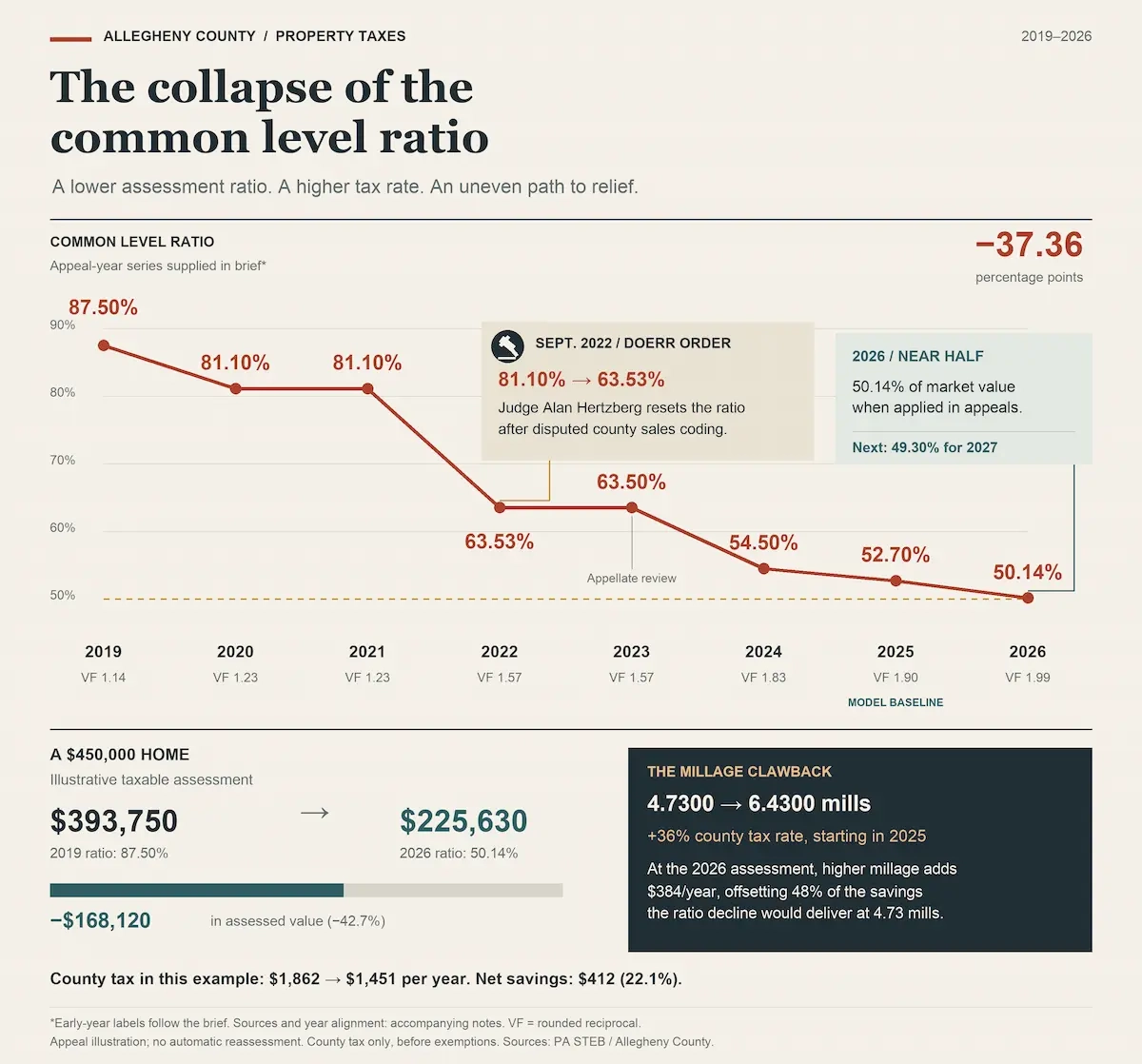
When the Pine-Richland School District prosecutes a reverse assessment appeal on a $450,000 purchase under the certified 52.70 percent ratio, the calculation sets a new assessment:
- Revised Assessed Value: $450,000 purchase price x 52.70% = $237,150
At the same time, Allegheny County Council approved Ordinance No. 13247-24, raising the county property tax rate from 4.7300 mills to 6.4300 mills to address structural budget deficits. When that higher county rate combines with the local municipal and school district millages, the Year 2 tax bill adjusts upward:
- Year 2 County Tax ($237,150 x 6.4300 mills): $1,524.87
- Year 2 Municipal Tax ($237,150 x 0.9980 mills): $236.68
- Year 2 School Tax ($237,150 x 19.5867 mills): $4,644.99
- Total Year 2 Property Tax: $6,406.54 ($533.88 per month)
This post-closing appeal increases the homeowner's annual tax burden by $837.31, pushing the monthly escrow payment up by $69.78 per month.
For a household holding an 80 percent loan-to-value mortgage of $360,000 on a 30-year fixed schedule, monthly principal and interest payments change by $2.4054 for each basis point of interest rate. Dividing the monthly tax increase of $69.78 by this sensitivity factor reveals that the reverse appeal is mathematically equivalent to an unexpected 29.0 basis-point interest rate hike on the mortgage. The borrower experiences the exact same monthly financial impact as if their lender had increased their note rate from 6.75 percent to 7.04 percent a year after closing.
In neighboring communities served by the North Allegheny School District, such as the Town of McCandless and Marshall Township, the impact is slightly higher. With McCandless municipal taxes at 1.2360 mills and North Allegheny School District at 19.7400 mills, total millage reaches 27.4060 mills. Upon reverse appeal at the 52.70 percent ratio, the annual tax bill reaches $6,499.33, or $541.61 per month.
"Most buyers have no idea that in Allegheny County, your closing day tax bill is basically an introductory teaser rate," says Tarasa Hurley. "When a family looks at a home in Wexford, their lender qualifies them on the seller's old taxes. They close, they unpack, and then ten months later a letter from the school district's solicitor lands in the mailbox. Suddenly their escrow jumps seventy or eighty bucks a month. When you are qualified right at the edge of your debt-to-income limit, that surprise hits hard."
Butler County: The 1969 Base-Year Fractional Tax Shelter Driving Northern Outflow
Crossing the northern border of Allegheny County into Butler County reveals an entirely different tax environment. Butler County has not conducted a countywide property reassessment since 1969, an interval of 57 consecutive years. Under Pennsylvania's base-year system, Butler County properties remain assessed based on what they would have been worth when Lyndon Johnson was completing his presidency.
Because real estate values have risen dramatically over nearly six decades, the State Tax Equalization Board certifies a Common Level Ratio Valuation Factor of 16.67 for Butler County. Inverting this statutory factor produces an effective ratio of 6.00 percent. As a result, a $450,000 single-family home in Butler County is assessed for taxation purposes at just 6.00 percent of its market value:
- Assessed Valuation: $450,000 purchase price divided by 16.67 = $26,994.60
Because taxable assessments are compressed to a tiny fraction of market value, local taxing bodies in Butler County must establish millage rates that appear startling at first glance. In Cranberry Township, the economic center of the southern Butler County corridor, the combined tax rates are structured as follows:
- Butler County Tax: 27.6260 mills
- Cranberry Township Municipal Tax: 13.2500 mills
- Seneca Valley School District Tax: 138.3200 mills
- Total Composite Millage: 179.1960 mills
While an aggregate tax rate of nearly 180 mills looks daunting on paper, applying that millage to an assessment of just $26,994.60 produces a surprisingly low carrying cost. Cranberry Township homeowners pay $745.75 in county taxes (27.6260 mills), $357.68 in municipal taxes (13.2500 mills), and $3,733.89 in school taxes to Seneca Valley (138.3200 mills).
The resulting annual tax bill comes out to exactly $4,837.32, or $403.11 per month in mortgage escrow. Dividing that total by the $450,000 purchase price reveals an effective tax rate of just 1.075 percent, the lowest carrying cost burden among the five benchmark communities.
Even when evaluated under older historical assessment benchmarks of 8.00 percent, where a $450,000 home carries an assessed value of $36,000, the annual tax bill in Cranberry totals $6,451.06 ($537.59 per month). But the structural advantage in Butler County extends beyond the initial rate. Unlike Allegheny County school districts, the Seneca Valley School District rarely initiates reverse assessment appeals on standard residential purchases.
The reason comes down to administrative cost. In Allegheny County, where the base year is 2012, school districts have extensive sales records and computer models to defend their appeals. In Butler County, defending an appeal requires hiring an appraiser to determine what a newly built four-bedroom home would have cost to construct using 1969 building materials and 1969 labor rates. Retaining an expert to prepare a retroactive 1969 appraisal costs a school district between $1,500 and $3,500 per property. For most standard residential transactions, the legal and appraisal expenses outweigh the potential tax gain.
As a result, Butler County's 1969 assessment roll functions as an unintended tax shelter for homeowners. Once a buyer purchases a home, their carrying costs remain remarkably stable.
This stability drives steady residential migration north along the Interstate 79 and Route 19 corridors. Comparing an appealed $450,000 home in Pine-Richland ($533.88 per month) to an identical acquisition in Cranberry Township ($403.11 per month) reveals a monthly difference of $130.77 per month, or $1,569.22 per year.
Applying the mortgage rate sensitivity model ($2.4054 per basis point per month on a $360,000 loan balance), this monthly savings represents a 54.4 basis-point interest rate advantage. A homeowner in Butler County enjoys the cash-flow equivalent of securing a 6.206 percent mortgage rate compared to a 6.750 percent rate on the exact same home in Allegheny County.
Evaluating regional relocation trends along the Route 19 corridor, Tarasa Hurley sees buyers experience initial confusion followed by relief once they understand how fractional assessments work.
"When people look at homes five minutes up the road in Cranberry Township, the math completely flips," explains Hurley. "If you look at the millage rate alone, taxes look astronomical. However, the dollar amount tells a different story. That 179 mills is being applied to a 1969 assessed value of twenty-seven thousand dollars. You end up saving over a hundred and thirty dollars a month compared to an identical house in Pine Township. That is like getting an automatic half-point discount on your mortgage interest rate, and the school district is not going to drag you to court next year to take it back."
Washington County: 2017 Reassessment Parity and the Southern Cross-Border Dynamic
South of Pittsburgh, the border between Allegheny County's South Hills communities, such as Upper St. Clair and Mt. Lebanon, and Washington County presents an entirely different assessment dynamic. Following decades of stagnant property rolls, the Washington County Court of Common Pleas ordered a countywide reassessment that took effect for the 2017 tax year. Conducted by Tyler Technologies, the revaluation eliminated old fractional ratios and established assessments at 100 percent of 2017 market values.
In suburban communities such as Peters Township, the transition to full market assessments created straightforward nominal millage rates:
- Washington County Tax: 2.4300 mills
- Peters Township Municipal Tax: 1.7000 mills
- Peters Township School District Tax: 16.2800 mills
- Total Composite Millage: 20.4100 mills
However, for buyers purchasing a home at full current market value under the 100 percent base roll, this structure creates the highest initial tax bill in the five-county region. At full parity, a $450,000 acquisition generates an initial tax bill of $9,184.50 ($765.38 per month), comprising $1,093.50 in county taxes (2.4300 mills), $765.00 in municipal taxes (1.7000 mills), and $7,326.00 in Peters Township school taxes (16.2800 mills). This baseline produces an initial effective property tax rate of 2.041 percent, nearly double the rate in Butler County.
Yet Washington County's tax system contains an important relief mechanism that many homeowners overlook. Since the 2017 reassessment was completed, real estate values in Peters Township have appreciated significantly. Because property rolls remained fixed at 2017 levels while market sale prices rose, the relationship between assessments and transaction prices drifted apart.
By 2025, STEB certified Washington County's Common Level Ratio at 68.00 percent (Valuation Factor 1.47). Under Pennsylvania Consolidated Statutes (53 Pa.C.S. § 8854), whenever a county's predetermined assessment ratio diverges from the state's certified ratio by more than 15 percent, the board of assessment appeals and the courts are legally required to apply the state ratio on appeal.
Calculating the divergence for Washington County shows that the 100 percent predetermined ratio differs from the 68.00 percent certified ratio by 47.06 percent, well above the 15 percent statutory threshold:
- Ratio Divergence: (1.0000 - 0.6800) divided by 0.6800 = 47.06%
Because this divergence exceeds the statutory threshold, any buyer who purchases a property in Peters Township for $450,000 has the legal right to file an assessment appeal. In that appeal, the Washington County Board of Assessment Appeals must recalculate the assessed value using the 68.00 percent ratio:
- Appealed Assessed Valuation: $450,000 x 68.00% = $306,000.00
Applying Peters Township's 20.4100 composite millage rate to the appealed $306,000 valuation resets each tax component: county taxes drop to $743.58, municipal taxes drop to $520.20, and school taxes drop to $4,981.68. The revised total annual tax comes to $6,245.46, or $520.46 per month.
Filing an appeal reduces the homeowner's annual tax burden by $2,939.04, delivering an immediate cash savings of $244.92 per month and lowering the effective tax rate from 2.041 percent to 1.388 percent.
This dynamic creates a strong migration draw for households living in southern Allegheny County. In communities like Upper St. Clair and Mt. Lebanon, combined school and municipal millages exceed 35 to 40 mills, and reverse appeals can push annual tax bills on $400,000-plus homes well past $10,000 to $12,000. Moving across the county border into Peters Township allows buyers to secure larger properties while benefiting from lower composite millage, provided they actively file an assessment appeal to correct their valuation.
"In Peters Township, buyers run into the exact opposite surprise if they don't know the rules," notes Tarasa Hurley. "Because Washington County did a reassessment in 2017, a four-hundred-and-fifty-thousand-dollar home is initially taxed on the full purchase price. Your first-year tax bill is over nine thousand dollars. But because the market appreciated so quickly, the state's certified ratio has dropped to 68 percent. If you file an appeal, you can knock nearly three thousand dollars a year off that bill immediately. It is substantial cash left on the table, yet many buyers go years without realizing they have the legal right to challenge it."
Westmoreland County: The Triple-Digit Millage Optical Anomaly on 1972 Assessments
East of Allegheny County, Westmoreland County operates under an assessment structure established in 1972. While county leaders established an official assessment ratio of 25.00 percent decades ago, more than fifty years of inflation and market growth have separated actual market values from the 1972 roll.
According to annual ratio studies conducted by the State Tax Equalization Board, STEB certifies a Valuation Factor of 11.49 for Westmoreland County. Inverting this factor establishes an effective Common Level Ratio of 8.70 percent.
Because taxable valuations represent less than one-tenth of real-world home values, local taxing authorities must levy exceptionally high nominal millage rates to generate operating revenue for schools and municipal services. In the Municipality of Murrysville and the Franklin Regional School District, the certified tax rates are:
- Westmoreland County Tax: 25.0000 mills
- Municipality of Murrysville Tax: 12.0500 mills
- Franklin Regional School District Tax: 111.8600 mills
- Total Composite Millage: 148.9100 mills
To buyers relocating from other parts of the country, a tax rate of nearly 149 mills creates immediate sticker shock. Many assume that their annual property taxes will consume 15 percent of their home's value every year. In reality, applying that 148.9100 composite millage rate to a properly aligned assessed valuation of $39,164.49 (based on the certified 8.70 percent ratio) yields an annual tax bill of $5,831.98 ($486.00 per month). That breaks down into $979.11 in county taxes (25.0000 mills), $471.93 in municipal taxes (12.0500 mills), and $4,380.94 in school taxes to Franklin Regional (111.8600 mills).
At $486.00 per month, the effective property tax rate in Murrysville is 1.296 percent, lower than post-appeal carrying costs in northern Allegheny County.
However, Westmoreland County's assessment roll exhibits severe internal disparities. While recent buyers who file appeals achieve assessments near the 8.70 percent ratio, many residential properties across the county remain on the tax rolls at older assessment benchmarks of 16.67 percent or the county's formal 25.00 percent ratio. On an identical $450,000 property assessed at the older 16.67 percent benchmark:
- Assessed Value ($450,000 x 16.67%): $75,000.00
- Annual Tax Liability ($75,000 x 148.91 mills): $11,168.25 ($930.69 per month)
This creates a massive annual tax difference of $5,336.27 ($444.69 per month) between two homes worth the exact same market price within the same school district. In communities across Murrysville, real estate carrying costs depend directly on whether a homeowner has reviewed their assessment and filed an appeal to bring their valuation in line with the state's certified 8.70 percent ratio.
Beaver County: The 2024 Reassessment Recalibration and Downward CLR Drift
To the northwest along the Ohio River corridor, Beaver County offers the most recent example of a complete countywide assessment reset. Prior to 2024, Beaver County operated on a 1982 base roll that had generated widespread assessment disparities. Following lawsuits filed by local taxing bodies, the Beaver County Court of Common Pleas ordered a comprehensive revaluation, which was completed by Tyler Technologies and implemented for the 2024 tax year.
When a county conducts a reassessment, the most important taxpayer protection is Pennsylvania's anti-windfall statute codified in Title 53 (53 Pa.C.S. § 8823). Under this law, taxing districts are not allowed to use a reassessment as a backdoor tax hike. In the first year following a revaluation, each municipality and school district must lower its millage rate so that total tax collections do not exceed previous revenue, with growth capped at 10 percent for municipalities and 5 percent for school districts.
In Brighton Township and the Beaver Area School District, the anti-windfall mandate required local authorities to reduce their millage rates sharply:
- Beaver County Tax: Recalibrated to 3.6700 mills
- Brighton Township Municipal Tax: Recalibrated to 2.2500 mills
- Beaver Area School District Tax: Recalibrated to 12.9900 mills
- Total Recalibrated Composite Millage: 18.9100 mills
Under initial base parity conditions, where a $450,000 home is assessed at 100 percent of market value, Brighton Township homeowners pay $1,651.50 in county taxes (3.6700 mills), $1,012.50 in municipal taxes (2.2500 mills), and $5,845.50 in Beaver Area school taxes (12.9900 mills). The initial annual tax bill totals $8,509.50 ($709.12 per month), producing an effective tax rate of 1.891 percent.
However, Pennsylvania assessment data shows that frozen base-year assessments begin diverging from market values as soon as a reassessment is completed. By 2025, STEB certified a Valuation Factor of 1.34 for Beaver County, which corresponds to a Common Level Ratio of 74.60 percent.
Checking this drift against the state's 15 percent rule reveals another appeal opportunity for home buyers:
- Divergence Calculation: (1.0000 - 0.7460) divided by 0.7460 = 34.05%
Because the 34.05 percent divergence easily exceeds the statutory 15 percent threshold, a home buyer purchasing a property in Brighton Township for $450,000 can petition the Beaver County assessment board to lower their assessment:
- Appealed Assessed Valuation: $450,000 x 74.60% = $335,700.00
Applying the 18.9100 composite millage rate to the reduced $335,700 assessment resets each levy: county taxes fall to $1,232.02, municipal taxes fall to $755.33, and school taxes fall to $4,360.74. The appealed annual tax liability drops to $6,348.09 ($529.01 per month).
Filing an appeal secures an annual reduction of $2,161.41 ($180.12 per month), bringing the effective tax rate down to 1.411 percent.
Across Beaver County, industrial investment connected to the Shell petrochemical complex and transit access along Interstate 376 has supported steady housing demand. However, buyers should be aware that post-reassessment stability does not last forever. Without filing an appeal to align their assessment with the state's Common Level Ratio, homeowners end up paying an extra $180 every month in real estate taxes.
The Political Third Rail: Why Pennsylvania Freezes Property Values in Time
Why does Pennsylvania tolerate a system where neighboring counties operate on assessments dating back to 1969 and 1972? The answer is not administrative oversight. It is political self-preservation.
In Pennsylvania local government, authorizing a countywide property reassessment is considered the ultimate political third rail. Under the Consolidated County Assessment Law, county commissioners are under no statutory mandate to perform regular revaluations. Unless forced by a taxpayer lawsuit or a judicial decree, county commissioners have every political incentive to leave the tax rolls frozen.
The political arithmetic is simple and ruthless. When a county conducts a reassessment, roughly one-third of residential properties see their taxes decrease, one-third remain roughly flat, and one-third experience sharp increases. The homeowners who receive tax reductions rarely organize in gratitude. But the homeowners whose annual taxes surge by thousands of dollars turn out to vote with intense anger. Elected commissioners who authorize reassessments are almost invariably defeated in their next party primary.
When Allegheny County implemented its court-ordered 2012 reassessment, the resulting public fury reshaped county politics for a decade. When Beaver County executed its court-mandated 2024 reassessment, commissioners faced hostile town halls and electoral backlash. Rather than touching that third rail voluntarily, county commissioners in Butler, Westmoreland, and dozens of other rural and suburban counties across the state simply leave their rolls frozen decade after decade.
To prevent this decades-long freeze from violating the Uniformity Clause of the Pennsylvania Constitution, the General Assembly established the State Tax Equalization Board. The Common Level Ratio was originally created as an arcane accounting formula to ensure fair distribution of state school subsidies. Over time, however, it has evolved into a permanent political pressure valve: an annual mathematical band-aid that allows county commissioners to avoid reassessments while forcing individual citizens and school districts to fight each other in court, one parcel at a time.
The Homeowner's Strategic Playbook: Critical Deadlines and Appeal Rules
For homeowners and prospective buyers navigating western Pennsylvania's fragmented assessment landscape, protecting household equity requires understanding the calendar and the math. A family that understands the assessment rules can save thousands of dollars, while an uninformed buyer can easily overpay for years.
Here are the essential operational rules:
1. The Calendar Is Absolute
Assessment appeal deadlines in Pennsylvania are strictly enforced jurisdictional cutoffs. If a homeowner misses the deadline by a single postmark date, the right to appeal is lost for that entire tax year:
- Allegheny County: The annual property assessment appeal deadline is March 31 for the current tax year.
- Butler, Washington, Westmoreland, and Beaver Counties: The annual assessment appeal deadline is August 1 or September 1, applying to real estate taxes for the following calendar year.
2. Watch the 15 Percent Statutory Trigger
Under Title 53 (53 Pa.C.S. § 8854), whenever a county's established predetermined ratio differs from the certified State Tax Equalization Board Common Level Ratio by more than 15 percent, the appeal board is legally obligated to apply the state ratio.
- In Washington County, where the predetermined ratio is 100 percent but the certified ratio has dropped to 68.00 percent, recent purchasers have an open statutory path to reduce their taxable assessment by 32 percent.
- In Beaver County, where the predetermined ratio is 100 percent and the certified ratio is 74.60 percent, buyers can appeal to reduce their assessed value by 25.4 percent.
Filing an appeal in these scenarios is not a contentious gamble; it is an administrative exercise of a statutory right.
3. The Sleeping Dog Rule in Fractional Counties
In counties with low fractional base years, such as Butler (6.00 percent ratio) and Westmoreland (8.70 percent ratio), homeowners should never file an assessment appeal unless their current assessed valuation significantly exceeds the certified statutory formula (Purchase Price x CLR).
Filing an assessment appeal opens a property's entire valuation history to scrutiny. Taxing districts receive formal notice of every appeal and have the right to cross-appeal, hiring appraisers to argue that recent interior renovations, finished basements, or outdoor amenities justify a higher valuation. In fractional base-year counties where school districts rarely initiate reverse appeals, silence is often the most profitable financial strategy.
4. Anticipate the Allegheny Reverse Appeal in Loan Underwriting
Buyers purchasing residential real estate in Allegheny County should never base their long-term housing budget on the seller's historical property tax escrow. If the purchase price multiplied by the 52.70 percent Common Level Ratio exceeds the current assessed value by more than $30,000, buyers should assume that the local school district will file a reverse assessment appeal within twelve to eighteen months. Qualifying mortgage borrowers should calculate their monthly debt-to-income cushion using the projected Year 2 appealed tax liability rather than the Year 1 closing disclosure.
Financial Modeling: Ten-Year Compounding and Mortgage Equivalence
To measure how these tax differences impact family finances over time, carrying costs must be projected across multi-year ownership horizons. Real estate carrying costs are dynamic; they interact with statutory inflation ceilings, mortgage underwriting limits, and long-term equity accumulation.
1. The Regional Baseline: Comparing All 13 Modeled Scenarios
To capture the true spectrum of regional housing costs, our model tracks thirteen distinct scenarios across the five core counties. These scenarios reflect both baseline conditions and statutory appeal pathways, including pre-appeal versus post-appeal valuations in Allegheny, Washington, and Beaver counties, alongside certified versus legacy assessment ratios in Butler and Westmoreland.
2. The Compounding Divide: 10-Year Wealth Divergence Under Act 1
While starting monthly escrow numbers reveal immediate cash-flow differences, the true cost of Pennsylvania's assessment system compounds over time. In Pennsylvania, public school district taxes represent between 65 and 80 percent of a homeowner's total annual property tax bill.
Under Pennsylvania's Taxpayer Relief Act (Special Session Act 1 of 2006), school boards cannot raise tax millage rates above an annual inflation index certified by the Pennsylvania Department of Education without voter approval. In high-demand suburban districts across the Pittsburgh region, this Act 1 index has averaged 4.00 percent per year.
Compounding an annual 4.00 percent increase on an initial $3,733.89 school tax bill in Cranberry Township produces a completely different long-term outcome than compounding 4.00 percent on a $7,326.00 school tax bill in Peters Township or a $4,644.99 post-appeal bill in Pine-Richland. Over time, that compounding effect turns an initial monthly difference into a massive capital gap.
3. The Mortgage Rate Equivalence Model: Converting Tax Escrow into Loan Terms
In residential mortgage underwriting under conforming Fannie Mae guidelines, property taxes are not treated as secondary utility expenses; they are evaluated dollar-for-dollar against monthly qualifying income. A monthly tax payment of $100 reduces a borrower's qualifying mortgage debt by the exact same amount as a $100 increase in loan principal and interest.
On a conforming 80 percent loan-to-value mortgage ($360,000 borrowed on a $450,000 purchase) over a standard 30-year term at benchmark rates between 6.75 percent and 7.00 percent, each basis point (0.01 percent) of interest rate shifts monthly payments by exactly $2.4054.
The Regional Monthly Escrow Leaderboard (Standard $450,000 Purchase)
When ranked from lowest ongoing monthly housing cost to highest, the five-county region reveals a clear hierarchy:
- Butler County (Cranberry / Seneca Valley, Certified CLR): $403.11 per month (1.075% effective rate)
- Allegheny County (Pine-Richland, Year 1 Baseline): $464.10 per month (1.238% effective rate)
- Westmoreland County (Murrysville / Franklin Regional, Appealed CLR): $486.00 per month (1.296% effective rate)
- Allegheny County (North Allegheny, 2024 County Millage): $508.02 per month (1.355% effective rate)
- Allegheny County (Pine-Richland, 2024 County Millage): $517.37 per month (1.380% effective rate)
- Washington County (Peters Township, Appealed CLR): $520.46 per month (1.388% effective rate)
- Beaver County (Brighton Township, Appealed CLR): $529.01 per month (1.411% effective rate)
- Allegheny County (Pine-Richland, Year 2 Appeal with 2025 County Millage): $533.88 per month (1.424% effective rate)
- Allegheny County (North Allegheny, Year 2 Appeal with 2025 County Millage): $541.61 per month (1.444% effective rate)
- Beaver County (Brighton Township, Un-Appealed Baseline): $709.12 per month (1.891% effective rate)
- Washington County (Peters Township, Un-Appealed Baseline): $765.38 per month (2.041% effective rate)
- Westmoreland County (Murrysville, Legacy 16.67% Ratio): $930.69 per month (2.482% effective rate)
These figures demonstrate that regional tax differences function like hidden interest rate surcharges. A buyer in Peters Township who pays taxes at 100 percent base parity incurs a monthly escrow penalty equivalent to adding 1.506 percent to their mortgage rate compared to buying in Cranberry. Even after winning an assessment appeal, buyers in Allegheny, Washington, Westmoreland, and Beaver counties experience ongoing monthly carrying costs equivalent to a 34.5 to 57.6 basis point interest rate penalty. Over a standard ownership period, that disparity redirects tens of thousands of dollars away from family wealth creation and into property tax bills.
Methodology, Statutory Framework, and Data Provenance
This research establishes an empirical financial model of real estate carrying costs across the five primary counties of the Greater Pittsburgh metropolitan area: Allegheny, Butler, Washington, Westmoreland, and Beaver. All calculations, statutory citations, and financial projections follow Pennsylvania assessment law and conforming residential mortgage underwriting standards.
1. Legal and Statutory Framework
The calculations and policy analyses in this report are grounded in the following governing statutes and court rulings:
- Consolidated County Assessment Law: Codified at 53 Pa.C.S. §§ 8801–8868, governing assessment roll management, countywide reassessments, Established Predetermined Ratios (53 Pa.C.S. § 8802), mandatory 15 percent Common Level Ratio variance rules (53 Pa.C.S. § 8854(a)(3)), and taxing district reverse appeal authority (53 Pa.C.S. § 8855).
- Anti-Windfall Post-Reassessment Limitation: Codified at 53 Pa.C.S. § 8823, requiring taxing jurisdictions to lower millage rates following a countywide revaluation so that total revenue growth does not exceed 110 percent for municipal governments and 105 percent for school districts.
- Special Session Act 1 of 2006 (Taxpayer Relief Act): Codified at 53 P.S. §§ 6926.101–6926.5005, limiting annual school district millage rate increases to the inflation index certified by the Pennsylvania Department of Education without voter approval.
- Constitutional Uniformity Clause: Article VIII, Section 1 of the Pennsylvania Constitution, which mandates that all taxes shall be uniform upon the same class of subjects within the territorial limits of the authority levying the tax.
- Key Judicial Decisions: Clifton v. Allegheny County, 969 A.2d 1197 (Pa. 2009) (holding indefinite base-year assessment freezes unconstitutional); Valley Forge Towers Apartments N, LP v. Upper Merion Area School District, 163 A.3d 962 (Pa. 2017) (prohibiting school districts from selectively appealing only commercial or high-value residential properties); Doerr v. Allegheny County, GD-21-007817 (Pa. C.P. Allegheny 2022) (ordering the State Tax Equalization Board to correct its Common Level Ratio calculations).
2. Primary Public Data Sources
All tax millages, assessment ratios, valuation factors, and budget metrics were gathered directly from primary public records:
- Pennsylvania Department of Revenue / State Tax Equalization Board (STEB): Certified Common Level Ratio Real Estate Valuation Factors Tables for Allegheny (52.70% / Factor 1.90 for 2025; 54.50% / Factor 1.83 for 2024), Butler (6.00% / Factor 16.67), Washington (68.00% / Factor 1.47), Westmoreland (8.70% / Factor 11.49), and Beaver (74.60% / Factor 1.34).
- Pennsylvania Department of Community and Economic Development (PA DCED): Official municipal tax statistics, certified municipal millage summaries, and local government tax registers maintained under Title 53.
- Pennsylvania Department of Education (PDE): Certified Act 1 inflation indices and approved school district operating budgets (Form PDE-2028) for Pine-Richland, North Allegheny, Seneca Valley, Peters Township, Franklin Regional, and Beaver Area school districts.
- County Assessment Authorities: Official tax schedules from the Allegheny County Office of Property Assessments (including County Council Ordinance No. 13247-24 establishing the 6.4300 county millage), Butler County Assessment Office, Washington County Tax Assessment Office, Westmoreland County Assessment Bureau, and Beaver County Assessment Office.
- Municipal Budgets: Certified tax ordinances and resolutions from Pine Township, Town of McCandless, Cranberry Township, Peters Township, Municipality of Murrysville, and Brighton Township.
3. Mathematical Formulas
- Assessed Value: In base-year jurisdictions, assessed value equals the purchase price multiplied by the certified Common Level Ratio or divided by the STEB Valuation Factor: Assessed Value = Purchase Price x CLR = Purchase Price / Valuation Factor
- Annual Property Tax Liability: Annual Tax = (Assessed Value x Total Composite Millage) / 1000
- Monthly Escrow: Monthly Escrow = Annual Tax Liability / 12
- Effective Property Tax Rate: Effective Tax Rate = (Annual Tax Liability / Purchase Price) x 100
- Cumulative Compounding Liability: Calculated over time horizon T with an annual school inflation rate of g = 0.04 using finite geometric series summation: Cumulative Liability = T x (County Tax + Municipal Tax) + Initial School Tax x [((1 + g)^T - 1) / g] At g = 0.04, the 5-year factor is 5.4163 and the 10-year factor is 12.0061.
- Mortgage Basis-Point Equivalence: Evaluated on an 80 percent loan-to-value mortgage of $360,000 on a $450,000 purchase price across 360 monthly payments. Standard loan amortization formula: Monthly Principal and Interest = P x [r(1 + r)^N] / [(1 + r)^N - 1] where P = $360,000, N = 360, and r is the monthly interest rate. At 6.75 percent, monthly payment is $2,334.95. At 7.00 percent, monthly payment is $2,395.09. The 25-basis-point spread equals $60.14 per month, producing a marginal sensitivity of $2.4054 per basis point per month. Basis-point equivalence is calculated as: Basis Point Equivalent = Monthly Escrow Difference / $2.4054
4. Assumptions and Study Parameters
- Standardized Purchase Price: All models use a standardized baseline of $450,000 to represent a typical single-family residential transaction across suburban school districts in the region.
- Homestead Exclusions: Calculations exclude Act 50 and Act 1 homestead exemptions to maintain uniform comparisons across all scenarios. Primary owner-occupants who apply for the homestead exclusion can reduce their assessed value by modest amounts, typically lowering school property taxes by $150 to $350 per year depending on local gaming revenue distributions.
- Non-School Millage Rates: County and municipal tax rates are held constant over the five-year and ten-year projections to isolate the compounding impact of school district tax increases.
- Expert Contributor: Commentary on mortgage qualification, buyer behavior, and assessment appeals was provided by Tarasa Hurley, an external market analyst, real estate agent, and part owner at River Point Realty (head of the Tarasa Hurley Team, 7112 Church Ave, Pittsburgh, PA 15202; Phone: (412) 785-2080).


